
Since October 13, 2026, the Federal Communications Commission (FCC) has treated an online marketplace that lists a radio device and handles its warehousing, fulfillment, order processing or billing as marketing it, and from 2027 marketplaces must show a valid FCC ID where the customer buys. In the same ten months, the FCC added drones, consumer routers, power inverters and advanced robots made abroad to its Covered List. If you sell anything with a radio in it, from earbuds to inverters, you now need to know where every model stands.
In this article
What is an FCC ID, and which products need one?
Most products that send or receive radio signals need FCC equipment authorization before they can be marketed in the US. That covers anything with Wi-Fi, Bluetooth, cellular or another radio link: phones, routers, drones, security cameras, smart plugs, wearables, two-way radios and remote-control toys. Devices that go through certification get an FCC ID, printed on a label or shown on an electronic label in the device’s settings.
Some electronics are authorized another way, through a Supplier’s Declaration of Conformity (SDoC). Those have no FCC ID, and the new marketplace rule doesn’t require one to be shown for them.
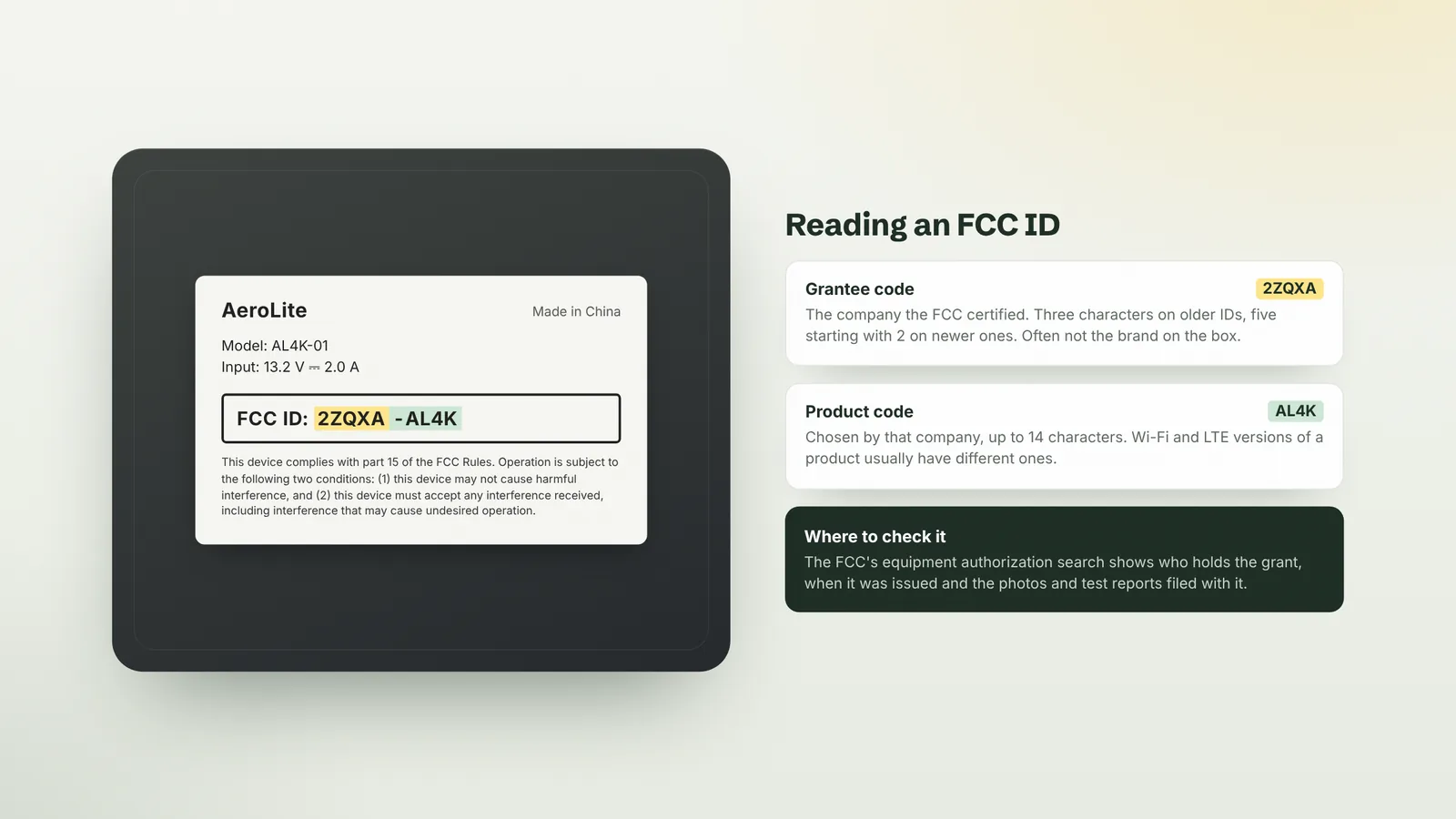
Four things trip up even experienced electronics teams:
- The company on the FCC record often isn’t the brand on the box. White-label and private-label products are usually certified by the factory or the original maker, so searching by brand finds nothing.
- One product can have several FCC IDs. The Wi-Fi and LTE versions of a tablet differ, and a supplier can change the radio module between batches.
- A real FCC ID can belong to a different product. An ID copied from a similar model passes a quick search but doesn’t match what you’re selling. The photos and manual filed with the grant show what it really covers.
- “Contains FCC ID” points to a module. Products built around a pre-approved radio module often show the module’s ID this way, so the FCC record names the module maker, not your brand.
What changed on October 13, 2026?
The FCC’s order on equipment authorization and the supply chain (FCC 26-50), adopted in July 2026 and published in the Federal Register on September 11, took effect on October 13. For anyone selling electronics online, it does three things.
Marketplaces count as marketers. Listing a radio device while also handling warehousing, fulfillment, order processing or billing is marketing it, even when a third party is the seller. The FCC applies its marketing rules to marketplaces “on the same basis as any other person,” with no requirement that the marketplace knew a device wasn’t authorized.
FCC IDs have to appear at the point of sale. Online marketplaces must show the FCC ID where the customer buys, on two deadlines:
| Marketplace | What it must show | From |
|---|---|---|
| Sells its own devices, or takes title to or has physical access to a third party’s device | A valid and accurate FCC ID for that exact device | March 1, 2027 |
| Hosts third-party listings without title or physical access | A valid FCC ID. Checking it against FCC records and requiring the seller to certify it limits liability if a seller’s ID is wrong | June 1, 2027 |
New devices can’t contain certain components. The FCC now prohibits authorizing a new device built with processors, modules or other logic-bearing parts from a Covered List company, where that company couldn’t get the device authorized itself. That rule lands on manufacturers, but it decides which new models reach your suppliers. The FCC announced its first use on October 22: it blocked two pending applications, a dash camera and a wireless video transmitter, each containing a chip from HiSilicon, a Huawei subsidiary.
Does the FCC ID display rule apply to your store?
The display rule borrows the INFORM Consumers Act’s definition of an online marketplace: a platform that lets third-party sellers sell consumer products. A single-brand store selling its own stock isn’t one. The marketing rule still applies to every store, though, so none can sell a radio device that lacks valid FCC authorization.
| Your store | What the rules require | Why it matters in practice |
|---|---|---|
| Store that lets outside sellers list, for example through a marketplace app or plugin | If it counts as a marketplace: show FCC IDs from 2027, and collect seller certifications | A fixed deadline, and every seller’s listings to bring in line |
| Store that also sells on eBay, Amazon or Walmart | The marketing rule | Since October 13, eBay says listings without a valid FCC ID may be hidden from US buyers |
| Store selling to schools, agencies or contractors | The marketing rule | Buyers screen out Section 889 brands, and federal grant money can’t buy drones from covered foreign makers |
| Single-brand consumer store | The marketing rule | Shoppers ask, and buying stock you can’t market is expensive |
Three exclusions apply to the display rule:
- Listings published before October 13, 2026, until they’re amended, updated or republished. Changing the description, images, specifications or seller information ends the exclusion. Changes to search ranking, layout, translation, price or currency don’t.
- Used devices, meaning devices previously sold at retail and marketed as used or otherwise not new.
- Third-party sellers below the INFORM Act’s high-volume threshold: 200 or more sales of new or unused products and $5,000 or more in revenue on that marketplace in any 12-month period within the last 24 months.
The rule also only covers devices that need FCC certification, so SDoC devices fall outside it.
What is the FCC Covered List, and what has been added?
The Covered List names communications equipment and services the US government considers a national security risk. Equipment in a covered category can’t get new FCC authorizations. For the drone and router entries, the FCC left models it had already authorized on sale, which makes a model’s grant date as important as its FCC ID. For the list’s older entries it has gone further, as the table shows.
| Date | Equipment | What sellers should know |
|---|---|---|
| December 22, 2025 | Drones and critical drone components produced abroad, plus DJI and Autel communications and video equipment | Models authorized earlier stay on sale. Blue UAS drones and Buy American domestic end products are exempt until January 1, 2028, and drones with a Conditional Approval are exempt with no end date. Some low-risk toy drones were taken off the list in June 2026. |
| March 23, 2026 | Consumer routers produced abroad | Models with a Conditional Approval from the Department of War or Homeland Security are excluded. Models authorized earlier stay on sale. |
| June 26, 2026 | Previously authorized equipment on entries added in 2024 or earlier, including Huawei and ZTE equipment and the Hytera, Hikvision and Dahua equipment the list covers | From July 2026, this equipment can no longer be imported or marketed, even models authorized years ago. Equipment already installed can keep operating. |
| July 28, 2026 | Power inverters and advanced robotic devices produced abroad | On August 20 the inverter entry was narrowed to utility-interactive inverters, and inverters eligible for the Section 45X manufacturing credit were exempted. The robot entry covers ground-moving robots over 4.4 pounds, dock included, that operate remotely or on their own with sensors, navigation software and a network connection. Both entries have a Conditional Approval route. |
Previously authorized drones and routers on the list can keep receiving software and firmware updates that protect consumers, such as security patches, at least until January 1, 2029.
What’s coming next?
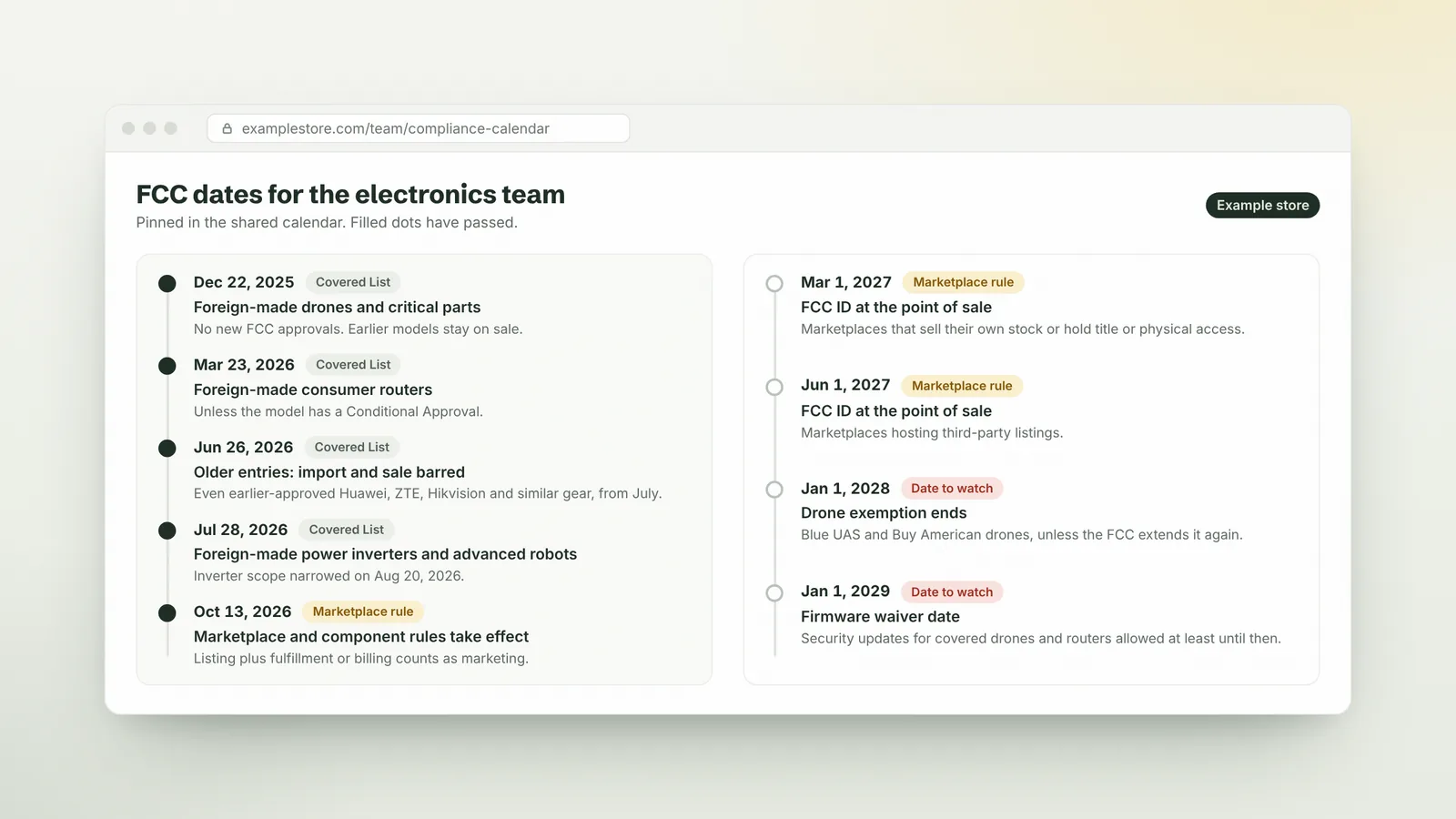
- March 1 and June 1, 2027: the two FCC ID display deadlines for marketplaces.
- January 1, 2028: the exemption for Blue UAS drones and Buy American domestic end products ends. It has already been pushed back once, from January 1, 2027.
- Proposals on drones: in July 2026 FCC bureaus sought comment on barring the import, marketing and sale of foreign-made drones in seven categories, including models already authorized: swarming drones, drones specially designed to integrate defense articles, thermal imaging drones, LiDAR drones, drones that dispense agricultural chemicals, docking stations and drones of 55 pounds or more. A separate notice proposed cutting off previously authorized equipment from nine named companies, eight of them drone makers.
- Marketplace guidance: the FCC told its Enforcement Bureau to consider issuing further best-practice guidance for marketplaces, drawing on Operation Clean Carts.
The direction is clear from the FCC’s Operation Clean Carts, run with large e-commerce platforms since October 2025: by May 2026 it reported over 3 million listings of covered equipment removed or blocked.
What does the FCC expect from marketplaces?
The FCC didn’t create a safe harbor, and it said good-faith efforts won’t excuse a pattern of problems, willful blindness or a failure to act after notice of a specific violation. It did say it’s unlikely to pursue a marketplace that shows reasonable due diligence, even after an isolated or inadvertent listing error, and it named these practices:
- Screening listings automatically for a valid FCC ID or SDoC information.
- Cross-checking seller-supplied FCC IDs against the FCC’s equipment authorization records.
- Requiring sellers to certify that the information is accurate.
- Investigating and removing unauthorized listings promptly.
- Keeping records of all of it.
The rule itself adds one protection for third-party listings: a marketplace isn’t liable under the display requirement for an inaccurate FCC ID supplied by a seller, if it took reasonable steps to confirm the ID was validly issued and required the seller to certify the information. That is separate from the due-diligence statement above, which the FCC says isn’t a safe harbor or a defense.
Why does this matter for every electronics store?
- Your channels already ask. Since October 13, eBay has prompted sellers for an FCC ID on applicable listings and warns that listings without a valid one may be hidden from US buyers. Amazon has asked for FCC authorization details on radio-enabled listings since March 2022: an FCC ID, the responsible party’s details, or a certified exemption.
- Stock is the expensive part. A model in a covered category with no authorization, or one swept up by a future rule, is inventory you can’t sell. Check before you place the purchase order, not after the container lands.
- Public-sector buyers check for you. Section 889 bars federal agencies from buying covered telecom and video surveillance equipment, and from contracting with companies that use it: Huawei and ZTE equipment, and Hytera, Hikvision and Dahua equipment for public safety and security uses, including their subsidiaries. Since December 22, 2025, the American Security Drone Act has also barred federal grant money for drones from covered foreign makers, and agencies often look for models on the Blue UAS Cleared List. Missing information loses the quote before you hear about it.
- The counter counts too. The display rule is about online sales, but the FCC’s marketing rule covers every sale, including in store. A device you can’t legally market can’t be sold in store either.
- Enforcement is per violation. The FCC can issue citations and fines (for most retailers, a citation comes first), and each day a violation continues can count separately. It can also refuse authorization, as it did on October 22 when it blocked two devices before approval.
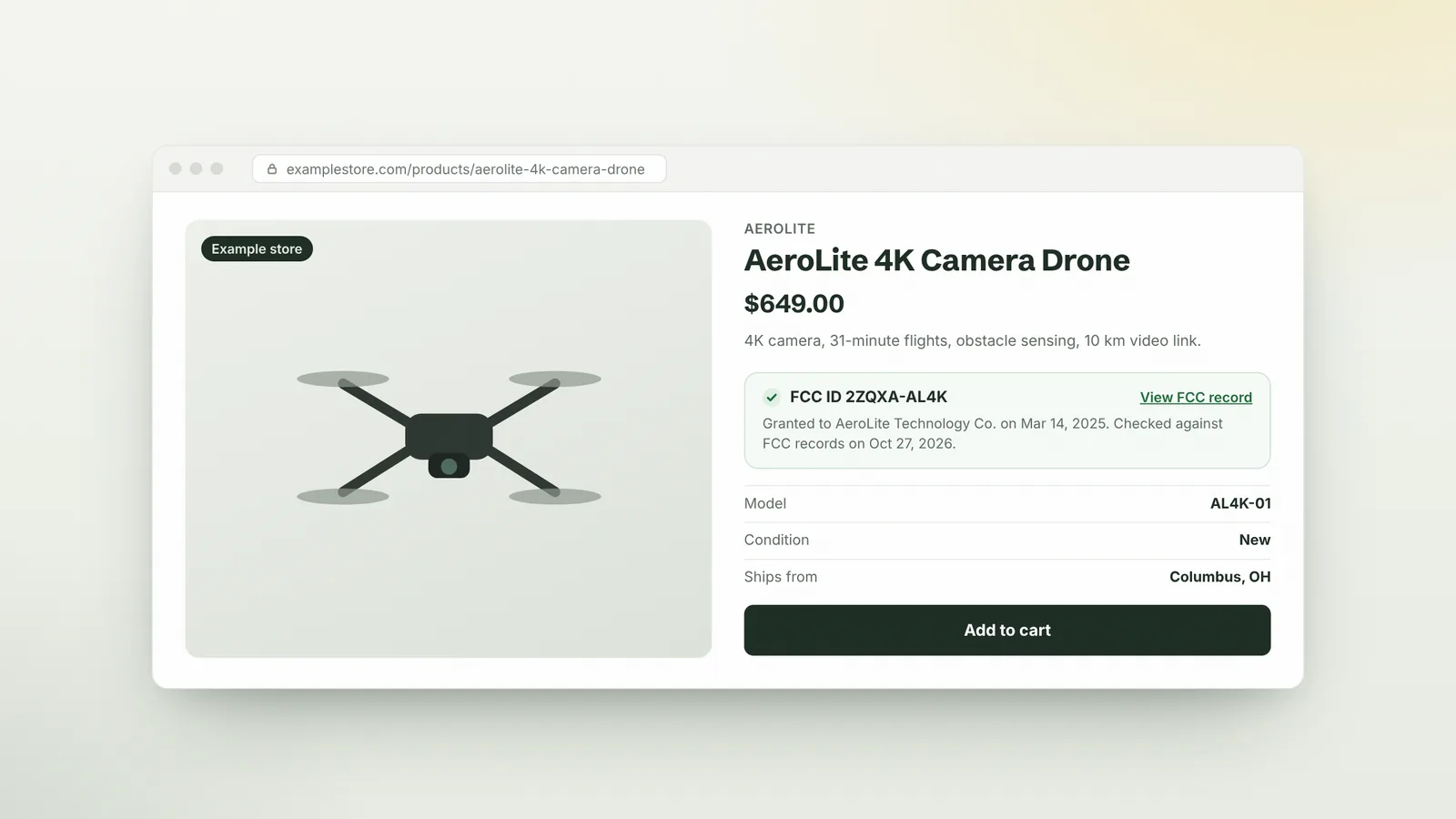
- Shoppers and buyers notice. An FCC ID on the product page, linked to the FCC’s own record, answers a pre-purchase question before it reaches your support inbox, and gives procurement buyers what they need to check out.
How do you get your catalog ready?
- Find every product with a radio in it. Search titles, product types and specifications for Wi-Fi, Bluetooth, LTE, GMRS and similar terms. Don’t forget remotes, modules and accessories.
- Record the FCC ID for each variant, not just each product.
- Check each ID against FCC records. Does it exist, who holds it, when was it granted, and do the photos and manual filed with it match your product?
- Flag Covered List categories, and compare each model’s grant date with its category’s date and exceptions.
- Mark the exclusions: SDoC devices, used items, and listings published before October 13 that you haven’t changed or republished since.
- Show the FCC ID on product pages and send it in your channel feeds.
- Ask suppliers for missing IDs in writing, with a photo of the label or electronic label.
- Check again on a schedule, and whenever the Covered List changes.
- Keep records: what was checked, when, and who confirmed it.
For 30 products, a spreadsheet and the FCC’s search page will do. For 3,000, with white-label ranges and suppliers swapping radio modules between batches, it stops working.
What does this mean on Shopify, WooCommerce, Magento and PrestaShop?
The rules are the same on every platform. Where the data lives isn’t. The FCC ID belongs on the product record that feeds everything else, at the variant level, because that’s where the radio changes.
| Platform | Store the FCC ID on | Keep in step |
|---|---|---|
| Shopify | A variant metafield, shown on the product page by your theme | Amazon, eBay, Walmart and Target Plus through Marketplace Connect, and Shopify POS in store |
| WooCommerce | A custom field on each product variation | eBay and Amazon listings sent by feed plugins |
| Magento (Adobe Commerce) | An attribute on each simple product behind a configurable one | Channel connectors, and on Adobe Commerce, B2B shared catalogs and quotes |
| PrestaShop | A product feature, or a module-added field on each combination, since combinations only carry identifiers like EAN and MPN | eBay and Amazon listings sent by connector modules |
The rules apply to devices marketed in the US, so they matter to any store selling to US buyers, wherever it’s based. That’s worth noting on PrestaShop, which is used mostly in Europe.
If the ID only lives in a spreadsheet or a supplier PDF, it never reaches the listing, the feed or the shop floor. Put it on the product once, and every channel inherits it.
Selling in a shop as well? Retailers that run one catalog for both, such as Shopify with Shopify POS, get the same answer online and at the counter. Our guide on when to switch to Shopify POS covers running both from one system.
Which multi-vendor apps, plugins and modules do marketplaces use?
On every platform, the line is the same. Once outside sellers list on your store and you process their orders or payments, you may count as an online marketplace under the rule, and the 2027 FCC ID deadlines apply to their listings. In practice, that usually means running one of these. They’re the established options on each platform, with the numbers behind them.
Shopify multi-vendor apps
| App | Developer | On the Shopify App Store |
|---|---|---|
| Multi Vendor Marketplace | Webkul | 4.7 stars from 364 reviews, listed since 2015 |
| Shipturtle Multi-Vendor | Shipturtle | 4.8 stars from 134 reviews |
| Puppet Vendors | Panther Commerce | 4.8 stars from 130 reviews |
| Garnet Multivendor Marketplace | Garnet Marketplace | 5.0 stars from 36 reviews |
WooCommerce multi-vendor plugins
| Plugin | Developer | On WordPress.org |
|---|---|---|
| Dokan | Dokan, Inc. | 30,000+ active installs, 4.6 stars from 769 ratings |
| WCFM Marketplace | WC Lovers | 10,000+ active installs, 4.6 stars from 449 ratings |
| WC Vendors | WC Vendors | 3,000+ active installs, 4.5 stars from 188 ratings |
| MultiVendorX | MultiVendorX | 2,000+ active installs, 4.8 stars from 432 ratings |
All four have a free core plugin on WordPress.org, with paid versions for features like seller verification and subscriptions.
Magento multi-vendor extensions
| Extension | Developer | Why it’s on the list |
|---|---|---|
| Multi Vendor Marketplace | Webkul | 4.4 stars in Adobe’s guide to multi-vendor extensions; Webkul is an Adobe Silver Technology Partner |
| Marketplace Multi Vendor Module | Purpletree | 5 stars in Adobe’s guide; listed for Magento Open Source and Adobe Commerce 2.4 |
| Magento 2 Multi-Vendor Marketplace | Ksolves | 5 stars in Adobe’s guide |
| Mirakl Platform connector for Adobe Commerce | Mirakl | For larger operators: runs a Mirakl marketplace on Adobe Commerce or Magento Open Source, maintained by Mirakl since 2015 |
PrestaShop marketplace modules
| Module | Developer | Why it’s on the list |
|---|---|---|
| Advanced Multi-Vendor Marketplace | Webkul | 4.9 stars from 107 reviews on Webkul’s store; PrestaShop 1.7, 8 and 9; Webkul is a PrestaShop Expert Partner |
| Multi Vendor Marketplace | Knowband | 10,000+ sales and 144 reviews, per Knowband; PrestaShop 1.6 to 9; a PrestaShop Partner Agency |
| Marketplace Builder | ETS-Soft (PrestaHero) | 5.0 stars from 116 reviews on PrestaHero; PrestaShop 1.6 to 9 |
What to test before you pick one
These tools are built around seller sign-up, commissions and payouts. FCC ID handling comes down to custom fields and approval rules, so that’s the part to test in a demo:
- Seller entry at variant level. Sellers can add an FCC ID to each variant or combination from their own dashboard, not only to the parent product.
- Required where it counts. You can make the field mandatory for categories with radios, and hold a new listing for review before it goes live.
- It reaches the page and the feeds. The ID shows on the product page and travels with the listing to Google, eBay and Amazon.
- Seller certification. Your seller terms, or a checkbox at listing time, confirm the ID is valid for that exact product.
- A record of changes. You can see who entered or changed an ID, and when.
What should a tool for this do?
If you’re comparing options, or deciding whether to handle this in-house, these are the jobs that matter:
- Find every product with a radio in it, including FCC IDs already sitting in descriptions, metafields and spreadsheets.
- Check each ID against FCC records and the Covered List, and check again on a schedule, not once.
- Match products by the company on the FCC record, so a white-label range is confirmed once rather than product by product.
- Rank what needs fixing by the stock behind it, and pause a listing without deleting it.
- Collect missing IDs from suppliers without long email chains.
- Show the FCC ID on the product page and send it to every channel.
- Raise an alert when the Covered List changes, with the affected products listed.
- Keep an evidence trail of every check and decision.
- For marketplaces, handle seller ID entry, seller certification and listing holds.
This is the work SignalProof, from Thrivepine, does inside the Shopify, WooCommerce, Magento and PrestaShop admin, for single-brand stores and multi-vendor marketplaces alike. Its marketplace mode follows the practices the FCC described: screening, cross-checking, seller certification, prompt removal and records. The FCC is clear that following them isn’t a safe harbor, but it’s what it said it will look for.
SignalProof reports what public FCC records show, and your team decides what to sell. It isn’t legal advice, and it isn’t affiliated with the FCC.
See where your wireless products stand
Tell us your platform and roughly how many wireless products you sell. We’ll walk you through SignalProof on your own catalog.
Questions electronics sellers ask about FCC IDs
Does the FCC ID rule apply to Shopify, WooCommerce, Magento and PrestaShop stores?
It depends on how you sell, not which platform you use. A store selling its own stock isn’t an online marketplace under the rule, so it has no display duty, though it still can’t market radio devices without valid FCC authorization. A store that lets outside sellers list through a multi-vendor app, plugin, extension or module may count as a marketplace, and then the 2027 FCC ID deadlines apply. Either way, eBay and Amazon already ask for the ID, and showing it on product pages answers a question shoppers ask.
Can I still sell DJI drones?
Models the FCC authorized before December 22, 2025 can generally still be sold, and owners can keep flying them. New models can’t get FCC authorization. The FCC has proposed barring sales of some foreign-made drone categories even when they’re already authorized, so check each model and follow that proposal.
What if a product has no FCC ID?
It may be authorized through a Supplier’s Declaration of Conformity, it may not contain a radio at all, or the ID may simply be missing. Ask the supplier for a photo of the label or electronic label. If a device that needs FCC certification has no valid FCC ID, don’t list it until it does.
Does the display rule cover used electronics?
No. Devices previously sold at retail and marketed as used or otherwise not new are excluded from the display requirement.
What happens if a listing shows the wrong FCC ID?
A marketplace selling its own stock must show an ID that’s valid and accurate for that exact product, so an ID that exists but belongs to another model doesn’t meet the rule. For third-party listings, the marketplace must show a valid ID; checking it against FCC records and requiring seller certification limits its liability if a seller’s ID turns out to be wrong. eBay may hide listings that are missing an FCC ID and can ask for documentation.
Is “NDAA compliant” an official certification?
No. There’s no government certification by that name. Section 889 of the FY2019 National Defense Authorization Act restricts federal purchases of covered equipment from five named companies and their subsidiaries. Sellers can state that a product isn’t made by those companies, but there’s no official badge to claim.
This article explains the FCC’s rules in plain language as of October 28, 2026. It isn’t legal advice; for decisions about your catalog, check with counsel.
Sources
- FCC 26-50, Third Report and Order and Federal Register, 91 FR 57798
- FCC news release, July 22, 2026 and Operation Clean Carts update, May 4, 2026
- FCC Public Notice DA 26-761 on drone exemptions, DA 26-635 on older Covered List equipment and DA 26-454 on firmware waivers
- Missouri DOT: American Security Drone Act grant restrictions and DroneLife: toy drone exemption
- FCC equipment authorization search
- Hogan Lovells Cadwalader: the FCC and online marketplaces and CommLaw Group: the rules are now effective
- Covington: first enforcement under the component rule and DroneXL
- Mayer Brown: routers added, inverters and robots added and Troutman: inverter entry narrowed
- Inside Unmanned Systems: drone exemptions extended and DroneXL: proposed drone sales ban
- Adobe: multi-vendor marketplace extensions for Adobe Commerce and Mirakl: Platform connector for Adobe Commerce; app, plugin and module figures from the listings linked in the tables
- eBay: FCC ID requirements and Value Added Resource: eBay’s FCC ID warning
- FTC: INFORM Consumers Act and FAR 52.204-25 (Section 889)